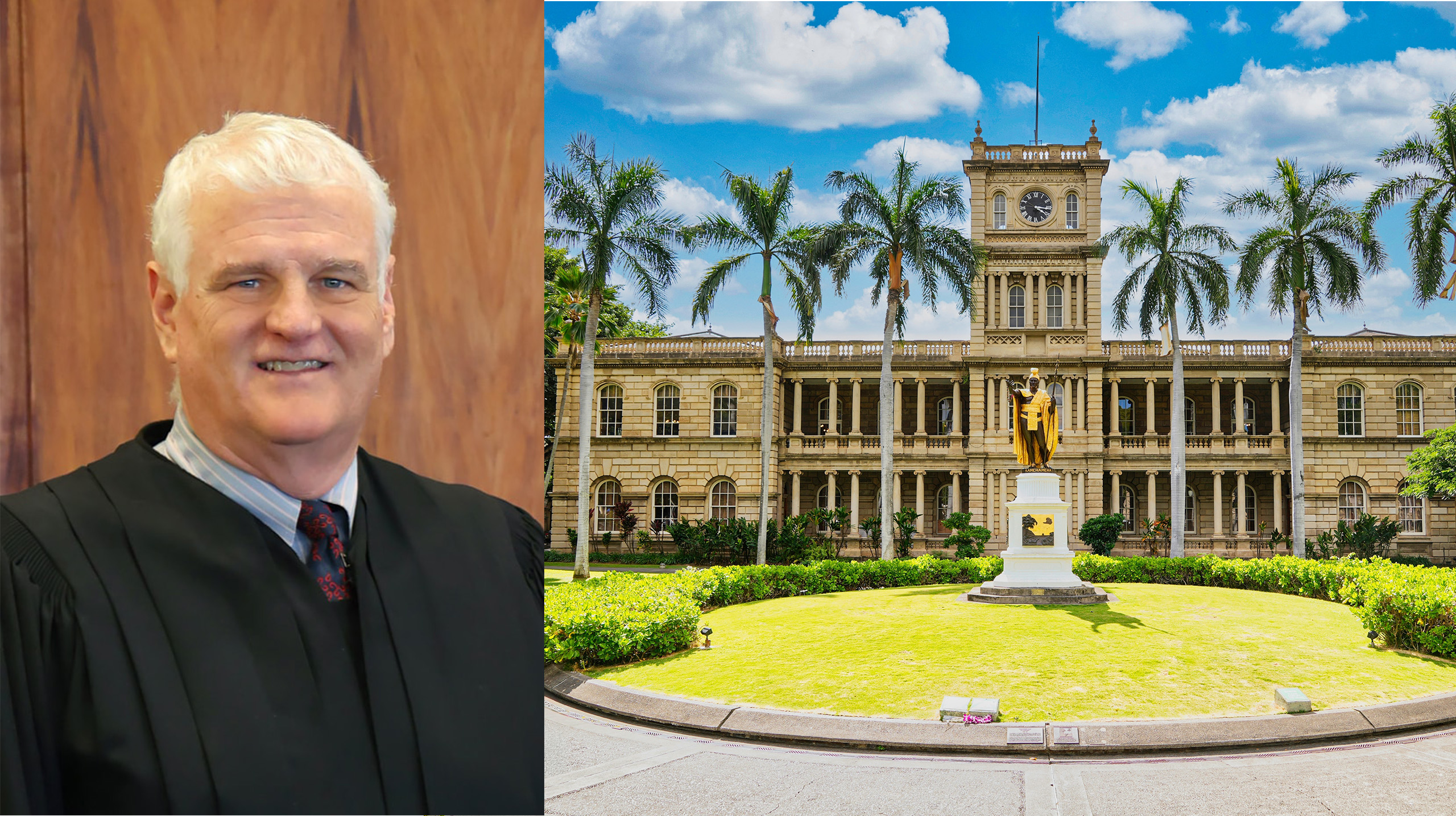
The National Judicial College has awarded former Hawaiʻi Supreme Court Chief Justice Mark Recktenwald its highest honor, the Sandra Day O’Connor Award. Chief Justice Recktenwald served as chief justice of Hawaiʻi’s highest court for 15 years, leading the court system through modernizations, transparency initiatives, and improved access to justice. Like the award’s namesake, Chief Justice Recktenwald has emphasized civics education.
Throughout his time leading the Hawaiʻi courts, Chief Justice Recktenwald brought the Spirit of Aloha to much of the court system’s work through collaborations with the legal community, innovative approaches, and a strong moral compass to represent the people of Hawaiʻi with a fair, responsive judiciary.
“The Aloha Spirit Law, which is part of our Hawai’i Revised Statutes, says that we treat each other with respect and with kindness. The Hawai’i Supreme Court has cited it in cases,” Chief Justice Recktenwald said. “It’s a recognition that we have a very unique state with a very unique history and that we continue today to practice the core values of Aloha. We need to respect our historical traditions. Treating each other with kindness, respect, generosity, and grace is an important part of who we are as a people.”
In the court system, this concept translated into new initiatives designed to meet the needs of the community, expand access, and build public trust and confidence in the courts.
“He is deeply committed to finding ways to broaden understanding of the role of the judiciary among people of all ages,” said Dean Emeritus Avi Sofier in his nomination letter. “His genuine modesty is linked, paradoxically, to his rare ability to build and sustain relationships and to address bottlenecks that impede access to justice for all. In this way—as well as in his recognition of the need for practical responses to the human costs of legal barriers—he echoes Justice OʻConnor’s emphasis on public education as well as on judicial pragmatism.”
Since retiring from the Hawaiʻi Supreme Court in 2025, Chief Justice Recktenwald has been involved in promoting the rule of law through Keep Our Republic’s Alliance of Former Chief Justices, which brings together state supreme court chiefs whose decades of leadership in their states’ judicial systems give them insight into upholding constitutional principles, protecting individual rights, and ensuring courts remain impartial forums for all.
Civics Hawaiʻi
Under Chief Justice Recktenwald’s leadership, the Supreme Court created the Hawaiʻi Commission to Promote and Advance Civic Education in 2021, which includes members appointed by the Court, the bar, schools, libraries, the federal court, a local university, and the state legislature. The PACE Commission’s work falls into two focus areas: Civics Education and Civic Engagement. Each year, the program reaches thousands of students and adults through events that often pair judges and attorneys.
“If Hawaiʻi’s civic education movement has a superhero, it is Chief Justice Recktenwald, who acts with a quiet, sincere conviction: no cape, no fanfare, staying until the last question is answered,” Lisa M. Ginoza, chair of the PACE Commission, said. “Chief Justice Recktenwald has been the person who always shows up. He shows up for students, teachers, librarians, and even the small rural school on a neighbor island that has never had a justice visit.”
Another hallmark civics initiative is Courts in the Community, in which the Hawaiʻi Supreme Court holds oral argument in schools across the state. Local attorneys volunteer to meet with students to explain the case before each argument, and the students have separate Q&A sessions with the attorneys and then the justices after the argument. More than 6,000 students from 70 schools have attended, leaving them with a better understanding of the judicial process.
Expanded Access to Justice Programs
Like most states, Hawaiʻi recognized that many residents struggled to navigate the courts and find legal representation. Chief Justice Recktenwald championed creating courthouse self-help centers in every judicial circuit through a sector-wide collaboration among the Courts, the Hawaiʻi State Bar Association, county bar associations, and the Legal Aid Society of Hawaiʻi. To date, the program has resulted in more than 40,000 free legal consultations to self-represented litigants facing custody, eviction, and other civil matters.
“Through collaborative leadership, visionary systems thinking, and genuine relationship building, “CJ” turned Hawaiʻi’s courts into a national leader in access to justice,” David Kauila Kopper, executive director of Legal Aid Society of Hawaiʻi, said. “He builds coalitions and movements from the ground up, founded upon genuine relationships and a genuine care for the people of Hawaiʻi.”
Because of limited resources, Hawaiʻi’s self-help centers rely on volunteer attorneys, who often have concerns about liability insurance, conflicts of interest, time commitments, and scope of practice when asked to engage in a pro bono program.
“We tried to make it as straightforward as possible, and we listened very carefully to the concerns the lawyers expressed,” Chief Justice Recktenwald said. “We systematically addressed each one of those issues. We really made it as easy as possible for attorneys to be able to come in, do a three-hour shift after being trained, have very clear guidance as to issues related to conflicts, and also be supported in terms of liability coverage. Another key component is working with our Legal Aid partners to provide administrative support for the self-help centers.”
Access to justice advocates regularly rank Hawai’i in or near the top 5 nationally.
“I think we built a real culture around the notion that you should do something. Whatever that something is, you should do something,” Chief Justice Recktenwald said.
Specialty Courts
Building on the success of problem-solving courts developed in the early 2000s, the Hawai’i courts studied and expanded upon the alternative court structure to launch other innovative courts, including a veteran’s court, an environmental court and a women’s court, the first of its kind in the country.
“We looked at each population we were trying to help, determined the needs of that population, and structured the court to be as effective as it possibly can be,” Chief Recktenwald said.
Women’s Court, or Mohala Wahine, started in 2023, recognizes that women often have a different pathway into the criminal justice system. This trail is often littered with episodes of abuse, neglect, and trauma — histories that are not easily overcome sitting in a jail cell. Women’s Court focuses on rehabilitation, therapy, and wraparound services over the long term, with the goal of preventing recidivism and a cycle of criminal justice involvement that extends to families.
“We learned that we could achieve better results in the criminal justice system by treating individuals as . . . individuals,” Chief Recktenwald said.
Continuing to Lead
Under Hawai’i’s mandatory retirement age for judges, Chief Justice Recktenwald stepped down in October of 2025. But retirement did not last long. He immediately began working with what became the Alliance of Former Chief Justices to advance the ideas he championed as chief justice.
“The ability of having former justices who can be candid about the challenges facing the judiciary, and why the rule of law needs to be defended is an important role that former chiefs can play,” Chief Recktenwald said. “We really do need folks who are able to speak on behalf of the judiciary to explain to the public why, for example, following the orders of the court is something that we all have to do. If we disagree with the ruling, the remedy isn’t to ignore it. The remedy is not to impeach the judge. The remedy is to take the case up on appeal. To explain some of these fundamental principles to the public in a way they can understand, I think is very, very important.”
Over the past year, Chief Justice Recktenwald has written opinion editorials, appeared on national television, and worked to inspire judges from around the country to become more engaged with their communities.
“Criticism of judicial opinions is absolutely legitimate. It’s important. I think it’s part of our democratic process to have folks engage in vigorous debate about whether this decision was right or wrong, whether it was correct or not, whether it was misguided or not,” he said. “But personalizing the anger, resentment or disagreement they might feel about a particular decision toward the judge is very problematic. Criticism is one thing, but unfounded personal attacks are quite another.”
About the Award
Chief Justice Recktenwald will receive the Sandra Day O’Connor Award during the national Appellate Judges Education Institute Summit in Philadelphia on November 12. Previous award winners include Judge Mary Russell, Missouri Supreme Court (2025); Justice Margaret H. Marshall (Ret.), Mass. Supreme Court (2024); Judge Rya Zobel, U.S. District Court (2023); Judge Bernice B. Donald (Ret.), U.S. Court of Appeals (2022); and Justice Sandra Day O’Connor, U.S. Supreme Court (2021).
The National Judicial College has awarded former Hawaiʻi Supreme Court Chief Justice Mark Recktenwald its ...

The Hon. Leslie A. Hayashi (Ret.), a retired district court judge from the First Circuit in Honolulu, Hawai...

The National Judicial College has named Dean Aviva Abramovsky as its next president and chief executive off...

Ernest C. Friesen, Jr., the first dean of The National Judicial College, passed away on December 11, 2025, ...

The National Judicial College has awarded Missouri Supreme Court Judge Mary Russell with the Sandra Day Oâ€...