Adjudicating Groundwater: A Judge’s Guide to Understanding Groundwater and Modeling
Unique Resource for Groundwater “Judges”
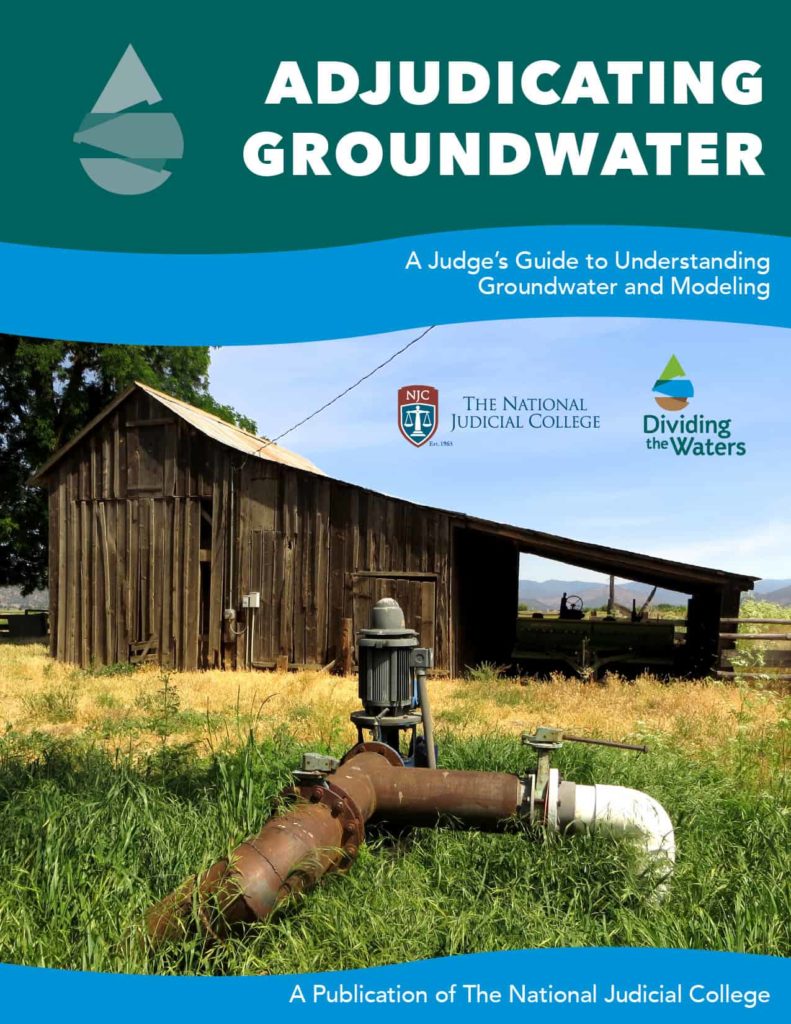
Dividing the Waters and the National Judicial College offer this groundwater science bench book drawing on the expertise of academic scientists, federal scientists, and judicial officers to create a resource that will assist judges deciding groundwater conflicts. The bench book explains the fundamentals of groundwater science and modeling, and offers checklists and a glossary. It received peer review from scientists and judges, with oversight from the U.S. Geological Survey and is among the most reliable resources for judges with water cases. It also offers water agency and state water officials an understanding of how a judge might approach questions on the science of aquifers.
The last chapter, written by Dividing the Waters’ own Judge Eric Wildman (Idaho), explains how a judge can apply the traditional Daubert factors in assessing the reliability of a groundwater model presented in court. Judge Wildman has first-hand experience of overseeing the development and then adjudicating a groundwater model for the aquifer providing water Idaho’s fertile Eastern Snake River Plain. He explains how a judge can ask good questions about a model’s development before making a judgment. He offers his colleagues judicial checklists, and the book includes a glossary for easy reference.
Essential Tool for Non-Science Decisionmakers
A growing number of government officials play some role in the management of the nation’s groundwater aquifers. They may be water agency or state water officials. Many do not have the expertise in groundwater science. Adjudicating Groundwater offers those officials insight into how to make their best decisions, as well as an understanding of how a judge who may review their decisions would approach some of these questions on the science of their aquifer.
Critical Time for Groundwater Decisions
Climate change and growing water demands make this a critical time for decisions on how to manage the nation’s groundwater. In the East, governments have encountered declining groundwater and growing conflicts. In the West, declining groundwater has led to conflict and significant legal change.
Getting Your Copy
Judges can download a free digital copy of Adjudicating Groundwater by clicking here.
Financial Support
The Water Foundation provided major financial support for publication of Adjudicating Groundwater. The Water Foundation works with groundwater managers across the West and the nation to improve groundwater management.
The following law firms have provided additional financial support for the publication of Adjudicating Groundwater:
California:
Downey Brand LLP, Sacramento;
Kronick, Moskovitz, Tiedmann & Girard, Sacramento;
Somach Simmons & Dunn, Sacramento
Colorado:
Somach Simmons & Dunn
Idaho:
Barker Rosholt & Simpson LLP;
Stoel Rives
Utah:
Clyde Snow & Sessions, PC
Washington:
Cascadia Law Group